Wholesale Engine Oil Suppliers in Pakistan: What to Check Before You Sign a Contract
For most procurement managers and fleet operators in Pakistan, selecting engine oil suppliers is usually a routine purchase decision. But in practice, it is among the most operationally sensitive decisions a business can make. One product-quality issue in lubricants can cause a series of problems across engine performance, machine uptime, maintenance budgets, and customer delivery guarantees.
Over the past few years, the wholesale engine oil supply market has grown rapidly, yet the risk of counterfeit products, contaminated batches, and unreliable supply chains has increased. Most businesses do not even consider the cost of a bad supplier relationship until engines become inefficient, the rate of breakdowns rises, or warranties begin to fail.
This is why assessing bulk lubricant suppliers in Pakistan requires much more than just looking at price lists. It requires a systematic grasp of quality assurance, certification, logistics reliability, and contractual protection. Industrial lubricant companies such as Atlantic Grease and Lubricants Pakistan have proved that cost alone does not determine the long-term value of industrial lubricants, but rather consistency, authenticity, and technical trust.
Understanding Supplier Credibility and Market Standing
The initial level of analysis should focus on supplier credibility before entering into any contract. Credibility in the lubricant business is not merely about the size of the company; it is about business history, clientele, and reliability of supply.
Reliable wholesale engine oil suppliers are usually those with long-standing relationships with industrial clients, transport fleets, and manufacturing units. Such relationships exist due to time-tested performance. New or uncertified suppliers, on the other hand, can offer good prices but may lack the infrastructure to maintain quality or consistent supply.
Atlantic Grease and Lubricants Pakistan, for example, does not make its presence felt in the market through transactional sales but through long-term industrial alliances. This is indicative of a wider trend in the lubricant industry: stability is more important than immediate cost reduction.
As such, procurement departments need to critically consider whether a supplier has been able to maintain the supply of industrial lubricants under actual operating conditions, rather than relying on hyped claims.
Certifications and Quality Standards That Actually Matter
Certifications are not mere decoration in the lubricant industry; they are a technical demonstration of formulation purity and manufacturing discipline. When evaluating certified lubricant suppliers, procurement managers should consider internationally recognized standards such as ISO certification and API (American Petroleum Institute) approvals.

These certifications mean that the oil meets defined thresholds for viscosity stability, thermal resistance and wear protection. But certification is not sufficient. It should be supported by batch testing which can be traced and consistent labeling of products.
Atlantic Grease and Lubricants Pakistan align the production and distribution processes to established quality standards, whereby every batch of oil is formulated consistently. This minimizes chances of engine strain due to irregular viscosity or degraded additives.
Furthermore, companies should check whether suppliers perform periodic third-party laboratory tests. This is a step that is usually disregarded but it is among the most powerful pointers to the willingness of a supplier to ensure quality.
Quality Verification Before Bulk Procurement
Verification is necessary even when the whole issue is with known suppliers of wholesale engine oil. Engine oil is a chemically complex and slight variations in the formulation of the engine oil can have a large influence on the engine life.
Technical data sheets (TDS) and safety data sheets (SDS) should always be requested by the procurement teams before any order is finalized. These papers disclose viscosity grades, additive composition and performance tolerances when operating under various conditions.
Also, sample testing under controlled engine conditions is a crucial process to businesses with fleets or industrial equipment. Such testing is normally promoted by reputable suppliers such as Atlantic Grease and Lubricants Pakistan since it enhances transparency and long-term trust.
Checking is not a choice in the Pakistani market where counterfeit lubricants continue to be used, but a necessary risk control mechanism.
Pricing Transparency and the Reality of Bulk Purchasing
The price is a frequently negotiated point in any lubricant contract. But when it comes to industrial procurement, the lowest cost may not always equate to the lowest price.
Bulk lubricant suppliers in Pakistan differ widely in terms of pricing structure. Others provide aggressive prices, but sacrifice additive quality or packaging integrity. Some keep prices constant and guarantee similar performance of products in the batches.
Clear pricing must encompass explanations on taxation, logistics fee, storage and delivery schedules. Hidden cost structures are usually developed later on in contracts that at first seem cost effective.
Atlantic Grease and Lubricants Pakistan have a systematic pricing strategy, which is targeted at industrial customers, whose large-volume purchases are synchronized with supply cycles. This enables businesses to have a stable financial planning without being caught up in unexpected procurements.
Supply Chain Reliability and Delivery Consistency
Uptime is directly related to the availability of lubricants in industrial operations. A late delivery may stop the machines, disrupt logistics fleets, or pause production lines.
This is the reason why one of the most significant assessment criteria of wholesale engine oil suppliers is their reliability in the supply chain. It is not enough to evaluate the ability of a supplier to deliver, but also to evaluate whether they can deliver consistently based on different demand conditions.
An efficient supply chain encompasses warehousing, regional delivery channels and backup of transportation delays. These elements are also essential as without them even the best industrial lubricants become useless.
Atlantic Grease and Lubricants Pakistan focus on orderly distribution planning so that the clients obtain timely deliveries even in case of the high-demand cycles. This consistency in operations is a major distinguishing factor in a market where delays are the order of the day.
Contract Terms, Technical Support, and Long-Term Partnership Value
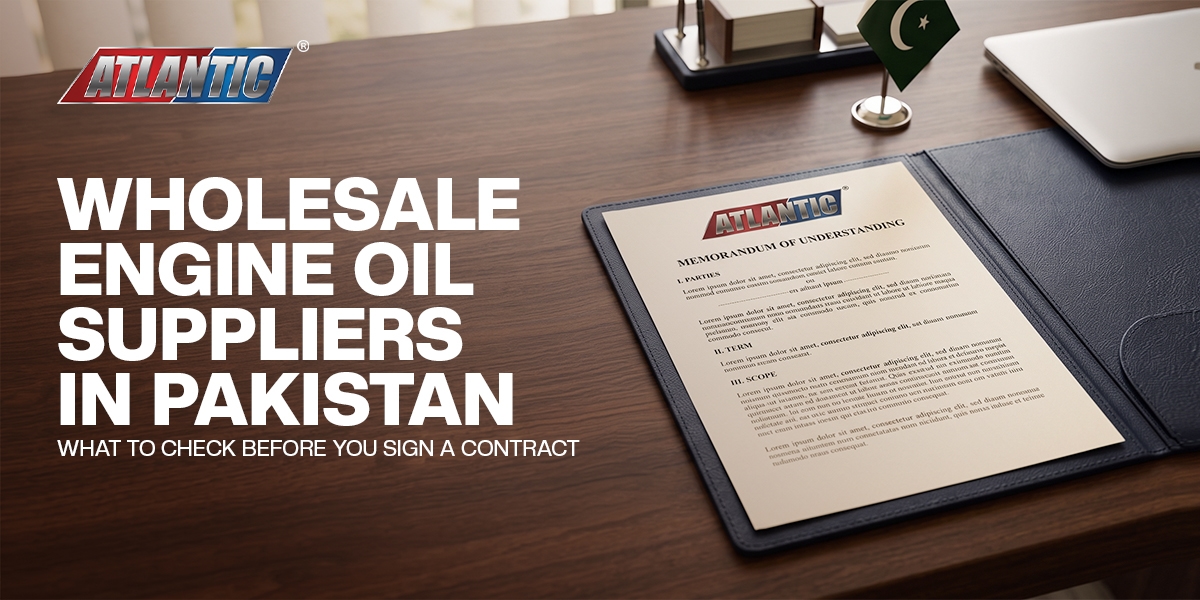
Lubricant supply contract cannot be a simple purchase agreement. Rather, it is supposed to be a technical partnership structure.
Delivery schedules, quality assurances, batch-traceability, and dispute-resolution mechanisms should be defined in clear contract terms. More to the point, they should describe technical support availability.
Many certified lubricant suppliers are currently providing technical advice services to their clients, and are assisting them in choosing the appropriate viscosity grades for specific engines or operating conditions. This aid minimizes the possibility of improper oil consumption, which is among the major factors that cause premature wear of the engine.
Atlantic Grease and Lubricants Pakistan are one such company that incorporates the technical advisory in its supply model, whereby clients not only buy their products but also get a tailor-made operational advice depending on the needs of their machines.
Risk Mitigation: Counterfeit Products and Lubricant Degradation
The presence of counterfeit or diluted products is one of the major issues in the lubricant market in Pakistan. Such products resemble the packaging of well-known brands but do not even meet the minimum standards of performance.
The consequences of the usage of such lubricants are dire. Engines suffer frictional wear, consume more fuel and wear internal parts faster. In the long run, it results in high maintenance expenses and shortened life of the assets.
To reduce such risks, procurements teams should focus on suppliers that have established distribution channels and traceable product sources. Atlantic Grease and Lubricants Pakistan have managed supply systems that limit exposure to risks of counterfeit products and offer product authenticity at all levels.
Also, the correct storage conditions are a disregarded factor. Even quality oil will spoil when stored in unfavorable temperature or moisture. Thus, supply chain integrity encompasses transportation and storage discipline.
Why Supplier Selection Defines Long-Term Performance
The decision on which wholesale engine oil suppliers to go is ultimately a decision on operational stability. Companies, which focus on certified quality, standardized supply, and technical maintenance have fewer failures and reduced costs of life cycle.
Conversely, choices that are made solely based on the short-term benefits of pricing tend to create uncertain maintenance processes and increase downtime.
This is where the well-established suppliers such as Atlantic Grease and Lubricants Pakistan have done their bit to stand out as not by the marketing claim but by the organized supply network, certified industrial lubricants, and reliable client servicing.
Building Procurement Decisions on Trust and Technical Proof
In a competitive industrial environment, lubricant procurement is not just a purchase—it is a risk management strategy. Businesses have to consider suppliers according to their credibility, certification, quality assurance, pricing transparency, and reliability of their supply chain.
Atlantic Grease and Lubricants Pakistan are one of the leaders in this field, as we incorporate all these in a unified supply model that is oriented for industrial performance and long-term collaborations.
For procurement managers who are interested in having reliable bulk lubricant suppliers in Pakistan, then they should not focus on the cheapest, but rather the most reliable supplier. That decision determines engine health, operational uptime and cost efficiency in the long-term.